NVIDIA Technology Partner

Dedicated GPU Infrastructure for AI Radiology

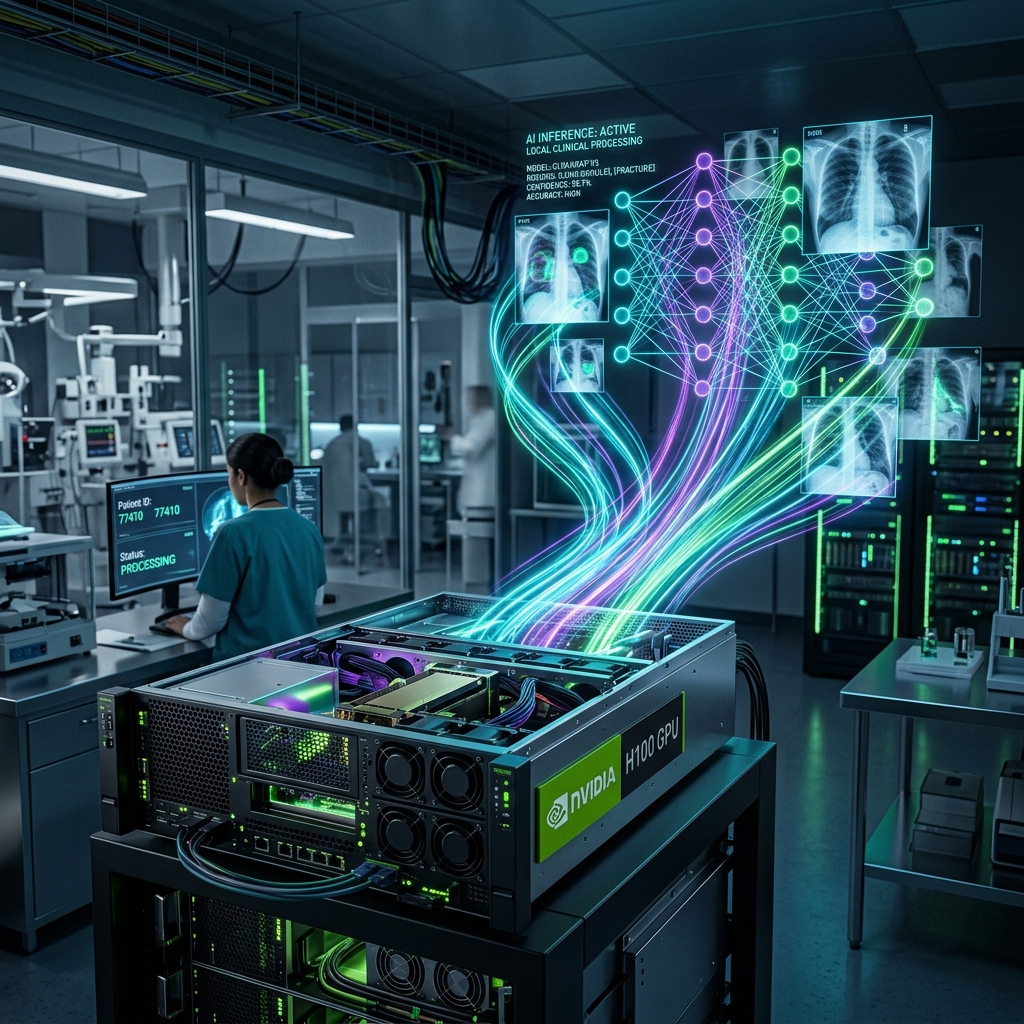
Processing raw DICOM images requires massive computational power. Veltneon operates on dedicated physical NVIDIA H100 clusters to deliver instant diagnostic diagnostics.

Clinical Inference Stack

Standard cloud API services route patient scans over shared servers. This introduces network bottlenecks, queue latency, and privacy compliance vulnerabilities.

Veltneon's platform, **Auravita**, deploys inside dedicated local hardware clusters. Every step—from DICOM matrix parsing to diagnostic segmentation overlays—runs natively on local hardware.

RADIOLOGY_FLOW_MAP
1. Imaging Device (PACS Router) DICOM Image Exports
2. Local De-Identification Node Demographics Scrub (HIPAA Protected)
3. NVIDIA H100 Inference Loop CUDA / TensorRT / NIM Container
4. Verified EHR Return (Epic/Cerner) FHIR Resource Upload
NVIDIA H100 GPU Local Inference Cluster for Radiology

Dedicated H100 Radiology Node

NVIDIA INCEPTION MEMBER PARTNERSHIP

NVIDIA H100 Hardware Layer

Leveraging the fourth-generation Tensor Cores and high-bandwidth VRAM of the H100 to execute convolutional segmentation neural networks in parallel, bypassing legacy delays.

Software Compilers & NIM Containers

Our deep learning pipelines are compiled via CUDA 12.4 and cuDNN, optimized with TensorRT, and containerized inside secure NVIDIA NIM microservices for easy deployment inside hospital subnets.

Simulated Performance

Inference Latency vs. DICOM Resolution

Adjust the slider to simulate DICOM image resolution size (in megabytes) and compare latency on Veltneon's local GPU stack against legacy cloud pipelines.

DICOM File Size

25 MB (Standard High-Resolution Chest X-Ray)
Veltneon H100 Stack (Simulated)
0.17s
Optimized with TensorRT local GPU execution.
Standard Cloud GPU Instance
1.94s
Subject to network overhead and database queues.

*Disclaimer: Latencies shown above are simulated based on early architecture testing. Real-world results vary based on regional intranet network speeds. All Veltneon products are currently in private beta testing.

Technical Architecture

The 7 Components of the Auravita Stack

Our pipeline is built on secure de-identification nodes and compiled on physical H100 GPU clusters.

01. Ingestion

DICOM Ingestion Layer

Interfaces directly with hospital PACS networks to ingest raw cross-sectional and skeletal scans, caching files inside local network buffers to prevent cloud transfer lag.

02. Security

PHI De-identification Filter

Strips all HIPAA Protected Health Information (patient name, date of birth, medical numbers) from DICOM headers inside hospital bounds before model processing.

03. Optimization

TensorRT Serialization

Compiles deep learning models into optimized execution paths using NVIDIA TensorRT, maximizing GPU register efficiency and scaling execution loops.

04. Hardware

NVIDIA H100 Compute

Runs deep learning diagnostics on dedicated local H100 hardware units, delivering multi-GPU acceleration to process chest scans in milliseconds.

05. Containment

Inference NIM Containers

Isolates model variables and weight parameters inside microservice containers, blocking external connectivity and securing patient demographics.

06. Segmentations

Diagnostic Segmentation Core

Runs deep learning neural networks to map X-ray matrices, locating fractures and nodules and drawing clear bounding box overlays.

07. Gateway

EHR FHIR API Gateway

Packages validation updates and segmentation indices into FHIR standard records, routing them to Epic/Cerner chart writebacks.

PACS EHR

Review Our Hardware Isolation Policies

We provide technical directors and security officers complete deployment charts, container specifications, and HIPAA audit declarations.